About this course
International Sign (IS) can be useful when communicating with Deaf people who use different signed languages, particularly in international, multicultural, and informal settings. For interpreters and translators, it can also provide a useful starting point for thinking about how visual communication can work when there is no single shared signed language.
This one-day online workshop introduces some of the key features of International Sign and gives participants opportunities to explore how it works in practice. We’ll look at ways of communicating across linguistic and cultural differences, and consider how visual strategies, gesture, shared signs, context, and adaptation can support understanding.
International Sign can be useful in a range of situations, including travel, international conferences and events, social settings, and contact with Deaf people from different countries or signing backgrounds. The session is designed to provide a practical introduction rather than expecting participants to already have experience of IS.
Through practical examples, discussion, and group activities, participants will explore:
What International Sign is and how it is used in practice
How communication can work when people do not share the same signed language
Ways to move beyond relying on signs from one particular language
The use of visual strategies, gesture, context, and internationally recognised signs
How to adapt signing depending on the person, situation, and shared understanding
Strategies for developing both production and receptive skills
Approaches to starting and maintaining informal conversations in International Sign
Activities will give attendees opportunities to practise communicating with others, try out different visual strategies, and reflect on what makes communication clearer and easier to follow.
Who is this session for?
This course is designed for sign language interpreters, translators, and others with advanced skills in a signed language who are new to International Sign or have only limited experience using it.
It may be particularly useful for those interested in international events, travel, working with Deaf people from different linguistic backgrounds, or simply developing greater flexibility in visual communication.
Learning outcomes
- Gain a clear introduction to how International Sign works
- Explore practical ways of communicating across signed language differences
- Develop greater flexibility in your use of visual communication
- Practise both production and receptive skills in a supportive setting
- Build confidence in starting and taking part in informal International Sign conversations
- Leave with practical strategies you can continue using and practising after the session
Live, interactive and supported
This is an active learning session with explanation, structured discussion and practical work. A useful course handbook or supporting materials are provided, together with a CPD certificate for each attendee.
Participation and cameras
Participation is encouraged. Cameras help people connect with those they are learning and working with, while recognising that there may be circumstances where having a camera on is not practical or appropriate.
Not recorded
This course is delivered live and is not recorded. Please book only if you can attend at the advertised time.
About the trainer

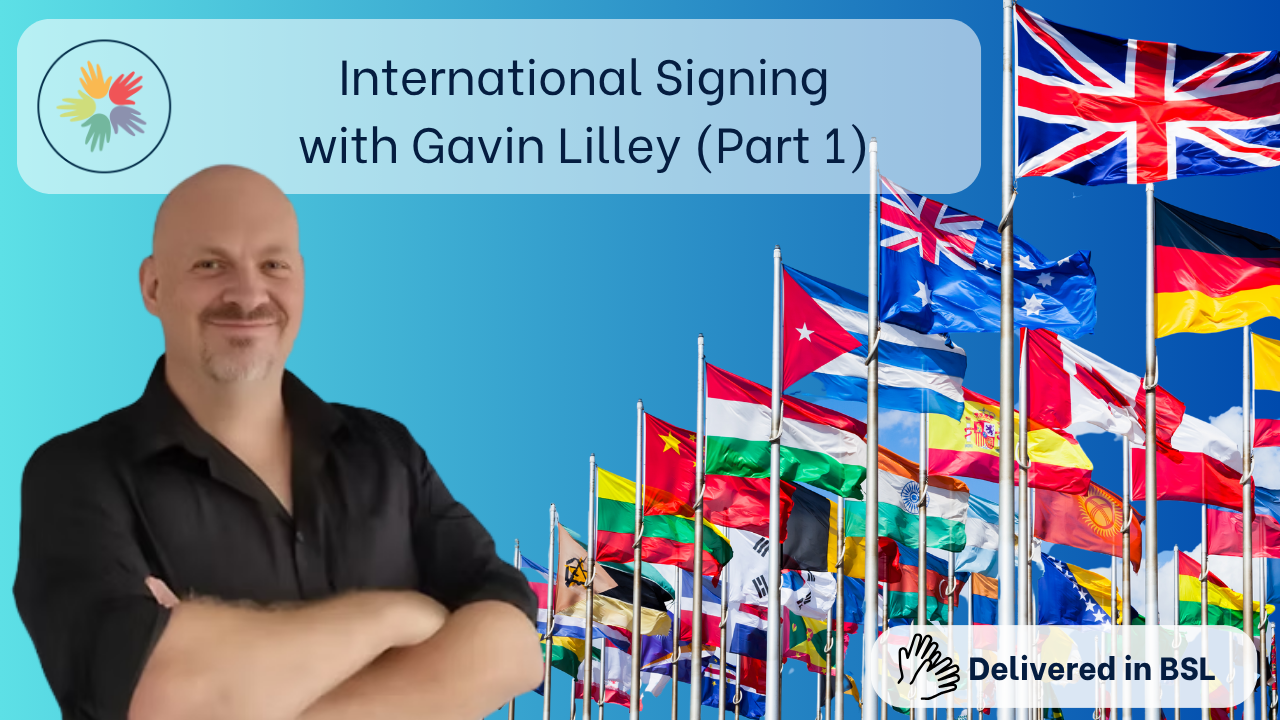
Gavin Lilley
Gavin Lilley is a Deaf Translator, BSL teacher, assessor, and trainer with more than 20 years’ experience in sign language education and professional development. A native BSL user from a multi-generational Deaf family, he brings both lived and professional experience to his teaching and training. Gavin has extensive experience teaching and assessing BSL from Levels 1 to 6 and has delivered training to thousands of learners across the UK. His teaching work has included the University of Central Lancashire, the University of Sussex, and a range of other organisations and training centres. Alongside his teaching and assessment work, Gavin delivers CPD for sign language interpreters, translators, students, and Deaf organisations. He has also worked as an anchor for an international Deaf news programme and as a Deaf Translator. Gavin has extensive experience of International Sign and is also fluent in American Sign Language. His training draws on his knowledge of BSL, translation, visual communication, and Deaf linguistic experience, with a practical focus on how these work in real communication.